Three Futures I: For Whom the Bell Tolls
2026-08-06
the first of three speculative looks at E&P in the next decades
July 2027
somewhere over grid zone Four Zero Romeo Delta Quebec
The deep blue of the strait, in the way that sensations sometimes do, sent Captain Ramirez’s mind careening through a series of oblique connections and sudden remembrances, terminating in: what on earth did Homer mean, “wine dark”? In the solitude of “angels 30”, with only the hiss of the oxygen system and the visceral thrum of the engine for company, such thoughts came easily.
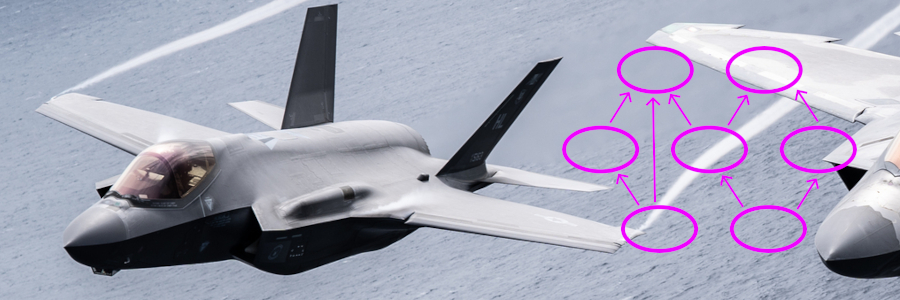
With the radar in standby mode, the F-35 was operating at “EMCON Alpha”; Ramirez and his aircraft would be nearly undetectable at the expense of forgoing the use of active sensors. This would be no real handicap. The F-35’s passive infrared sensors and radar warning receiver provided a basic situational awareness. More importantly, he had access to radar contacts from the AWACS orbiting 50 nautical miles to the southwest and high-resolution close range AESA radar scans from the “loyal wingman” autonomous drone 10 nautical miles dead ahead, all provided in near-real-time over Ku band tightbeam datalink. All of this raw data would be processed into a coherent picture of the “battlespace” by his own avionics, transforming radar returns, high-contrast infrared splotches, incoming signals, and datalink tracks into “bogeys” and “bandits” through a set of techniques his textbook had called sensor fusion.
Ramirez’s daydream was interrupted by a radio transmission from the AWACS. Before the radio operator had even finished saying his call sign, somewhere in the avionics bay an instruction pointer jumped to the object code of a hundred thousand lines of C++ which were to a Kalman filter approximately as Claude was to ELIZA. Over the next hundred milliseconds, seven discrete bogey indicators resolved to a single bright-red Bayesian smear approximately the shape and size of a MiG-21 (weak signals received by the RWR, cross-referenced with the intel database, drove the final modal belief to a Chinese-built F-7M with 85.6% probability); three others turned blue when merged with track projections of recent IFF responses and datalink handshakes; a final dot was discarded as probable noise. Captain Ramirez slewed the cursor over the red track and thumbed his TMS hat forward.
January 2029
Houston, Texas
Sarah sipped tentatively at her coffee and watched the blue spinner as the dashboard application retrieved last night’s updates from SHERLOCK. Where did HEB source that chemical that smelled like pecan pie, if pecan pie had been synthesized by a life form with right-handed proteins and an anaerobic metabolism on the basis of a mass spectroscopy report? And how could the company afford three million dollars a year in software and AI subscriptions, but not a coffee maker that didn’t run on “pods”?
No matter — the alert bell chirped a merry “ding!” and here were the results. Ahmed had mentioned that last night’s frac was a little hairier than expected. Largest changes, rank by EUR impact. Frac half-length, Johnson pad. Max-likelihood estimate up 15%! Strongest contributor: net-pressure vs time observation, incorporated last night at 23:12, Johnson 9H frac. Click, see other impacts from Johnson 9H frac data, rank by magnitude. Matrix permeability down 2%. Bleed off slightly faster than expected.
Zoom out to county level. Impact on PDP EUR? Down 0.5%. No big deal, but the bigger problem would be… inventory for optimal recovery under current well design. Down five wells! Sarah grimaced. She had been concerned about the well spacing. OK, let’s see that plan. Estimate impact of reducing proppant loading. Ten percent? Nominal change in EUR, significant cost decrease. Twenty percent? Too much. This would be unpleasant, but knowing was half the battle. (The other half, Sarah thought, was making slide decks to convince management.)
There had been plenty of skepticism when SHERLOCK was introduced. The “AI” craze that started a few years back had begun to wind down; engineers loved the ability to generate scripts and automate basic analyses (Sarah would die happier for never having to touch Excel VBA macros again), but language models hadn’t really “moved the needle” when it came to in-depth understanding of the reservoir. Their analysis could be on point, or it could be anything from glib and superficial to dangerously backward in a “tail wagging the dog” sort of way. Either way, you didn’t save that much time when it came to really understanding. Although she did like that even her office workstation now had a sort of “Siri” in lieu of click-click-click (nobody warned you that your hands really start to feel all that computer use in your thirties). And, come to think of it, she had spent a lot of time on maps and visualizations in the first ten years of her career, but it had been years now since that had been a major time sink. Still, in the end you just couldn’t automate away needing to think real hard sometimes.
On the other hand, all that beautiful training and inference hardware was now largely up for grabs (it turned out that the average Joe didn’t have that much need for “a video game kind of like that one I remember, but not fun” on tap). The sort of “sensor fusion” that SHERLOCK did didn’t really require big neural networks like the “AI” models did, but the people who built it (Sarah vaguely remembered a lunch-and-learn featuring a woman with the blandly precise voice she associated with her uncle who’d worked for the “State Department” and held three different ALL CAPS security clearances) had needed the ability to store and access huge datasets to calibrate it, and the nightly update runs needed fairly beefy hardware, not to mention the sheer volume (no pun intended) of the basin-level SHERLOCK models themselves.
SHERLOCK was at heart a completely deterministic system; the code itself could have been written twenty years ago. It was a probabilistic graphical model: a huge Bayesian network connecting reservoir dynamics to geophysical properties to operational constraints to produced volumes; it maintained probability distributions over every property of interest for each volumetric cell (1x1x1 meter cubes, in the latest models) of the reservoir. Any observation — a daily production volume, a shut-in with pressure readings, a frac report — would chain through the entire system following what amounted to a hugely iterated application of Bayes’ rule.
Finally, all the technical disciplines that constitute a modern E&P operation could collaborate in a real way, with a shared understanding of how their own observations, actions, and decisions impacted the overall state of an asset. Sarah had enjoyed getting to know her counterparts in completions, drilling, and geology better, and beginning to understand the way they thought about things and the decisions they made, although sometimes the sheer responsibility of having her own decisions legible across the entire asset lifecycle was a little overwhelming. No woman is an island…