How Far Apart Are Two Wells?
2026-07-15
This post originally ran on Collide and LinkedIn. It’s archived here with its original publication date.
Well spacing is a big deal these days. What’s typical in a play? (We need to estimate inventory.) Are we too dense or too sparse? (We keep revising reserves downward in proven rock.) How far away do we need to shut in to avoid frac hits? Can we classify these peer wells in terms of “parent”/“child” interactions?
When we consider these questions and how to address them using available data, we find that we need to quantify the distance between arbitrary wells. It’s a horizontal multi-frac world just about everywhere the money goes for the foreseeable future, so the precise question is: how far apart are two trajectories in three-dimensional space?
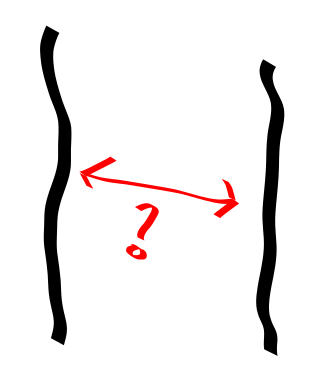
Well, how long is a piece of string? There’s more than one way to answer the question, and each comes with its own strengths and weaknesses. Like most of reality, there’s also a surprising amount of complexity to the problem, and a surprising number of small decisions to make along the way.
The first thing most people come up with is “take the average”. That can be fine! We’ll average… wait, what exactly? Each well trajectory is usually represented as a series of points in space, as measured by a gyro survey. We could average all pairwise distances between every point in the first well and every point in the second well trajectory.
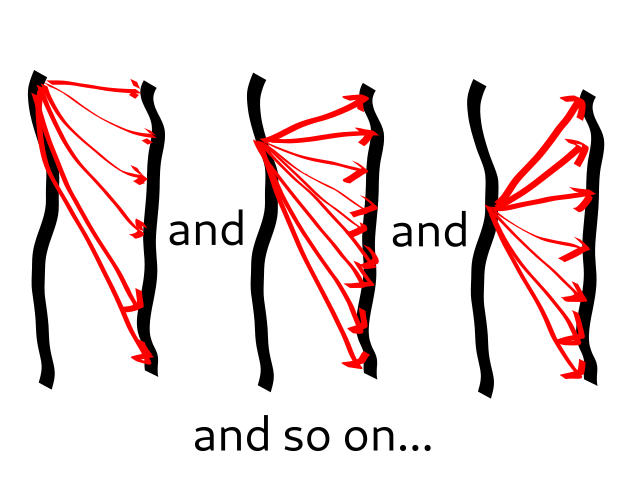
That’s a lot of work. Sidebar: there’s a piece of complexity I want to point out but won’t engage with because I want to keep this short. That gyro survey represents only a sampled subset of the (infinite) points which lie along the three-dimensional curve of the wellbore trajectory. Every method we’re going to cover here could be generalized to work on continuous approximations (Bézier splines, etc.) fit to the survey points; we’re going to hope instead that our surveys are reasonably accurate and dense, and just work with the sampled points.
Anywhow, as I was saying, that’s a lot of work! It’s also potentially misleading when the well trajectories get “weirder”. Do we really want the estimate here to be skewed by the long traces between points in the “heel” of well A and some points in the curved “toe” of well B?
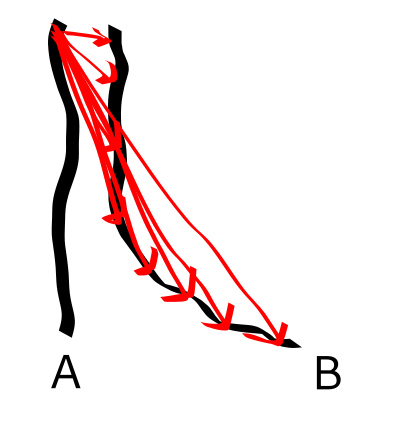
OK, we can do a bit better by replacing this “average of averages” approach with an approach that tries to capture our intuition that what matters is how close the wells are to each other “at each point”. One common way is to average the distance from each point in A to the closest point in well B. A refinement is to average the perpendicular distance from each point in A to the trajectory of B. (Why? We expect wells to be drilled such that fractures propagate roughly perpendicular to the wellbore; the argument is that we’re trying to measure the distance from A to B along the expected path of drainage.) Complexity sidebar: perpendicular to what? (Usually well A.) Distance to what? (The continuous track of well B. This usually requires us to approximate B by a sequence of line segments, and do a little math.) Does this mean that Distance(A → B) ≠ Distance(B → A)? (Hell yeah. Welcome to the Thunderdome.)
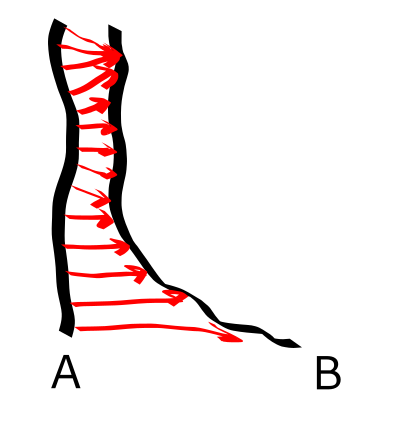
Here’s a related fun idea that gets us an interesting quick look number to spot well pairs that are very near to each other along their entire trajectories (and likely have little non-overlapped drainage, which is why I usually care when calculating these metrics). We can evaluate the Hausdorff distance between well A and well B.
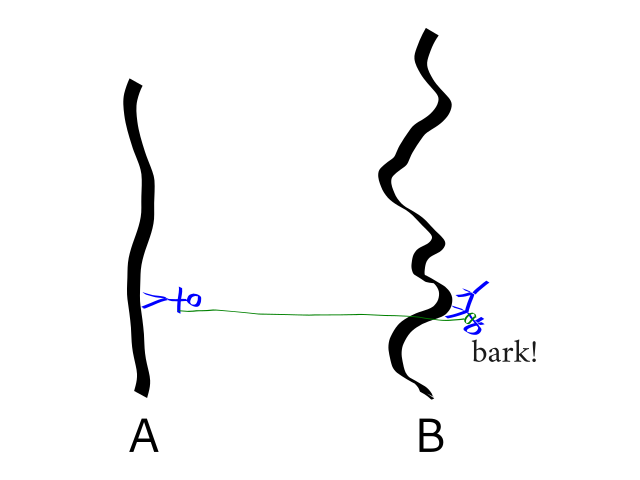
Imagine that you are walking your very free-spirited dog, on a leash. You’re walking along well A, and the dog is walking along well B. Both you can and the dog can rove freely along your respective wellbores.
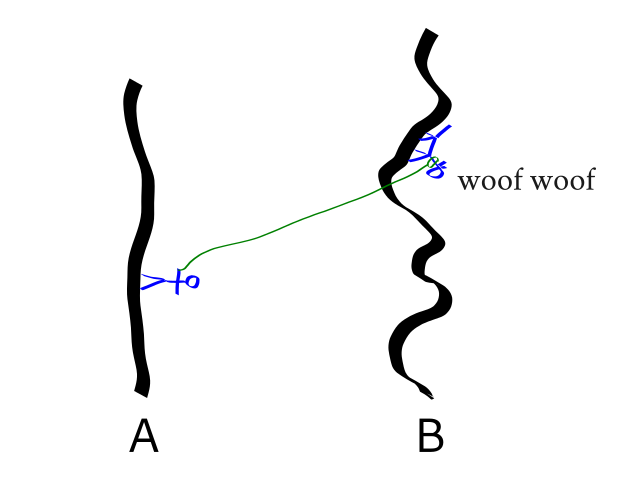
The dog wants to get as far away from you as possible, but you can always move along your own wellbore to keep up. What’s the shortest leash you can bring (without strangling your poor dog!), taking your respective ranges of motion into account? I think it’s this value right here—that’s the Hausdorff distance from A to B. (Note that the Hausdorff distance from B to A will be different; it matters which side is the dog and which side is the dog-walker. Another non-symmetric metric.)
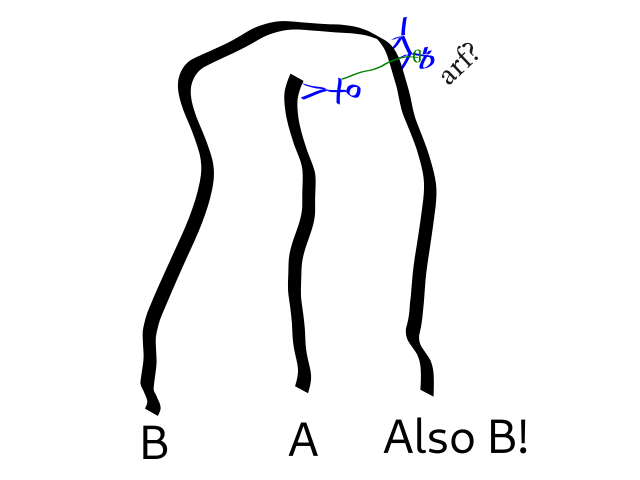
None of these metrics are perfect, and all can be actively misleading in some situations. We’ve got “U-turn” laterals now, so some previously unthinkable situations are now quite thinkable. We have wells whose nearest neighbors are, in a meaningful sense, themselves!
I’d love to see future developments in well spacing measurement. Personally, I think we could do better by somehow taking into account two-dimensional or even three-dimensional areas or volumes rather than distances. Something in the vein of integrating along the wellbore(s) to evaluate overlapped drainage area might get us metric more directly correlated to the performance impact of spacing. Maybe we need to include rock anisotropy and reservoir heterogeneity in our calculations, moving away from unadjusted Euclidean distances in space. I don’t know “the” answer, but I’m confident that this is an area with surprising depth and we’re not done iterating yet.